The Best Scalp Massager
for Hair Loss —
What the Science Actually Says
 Updated May 2026
 40+ Peer-Reviewed Studies
 20-minute read
 ScalpMassager.com Research Team
Most scalp massagers on the market do very little for hair loss. We reviewed the clinical literature, applied a six-point evaluation framework, and tested the leading devices. The result: one device is in a category of its own — not because of marketing, but because of the biology it targets.

Who This Review Is For
This review is written for people experiencing androgenetic alopecia (male or female pattern hair loss) who want to understand whether scalp massage is a legitimate intervention — and if so, which device is worth using. We are not affiliated with any manufacturer. Our conclusion is driven by published clinical evidence and a structured evaluation framework, not by advertising relationships. If you already use minoxidil or finasteride and wonder whether a scalp device can complement that, this review also addresses that question directly.
How We Evaluate Scalp Massagers for Hair Loss
The consumer scalp massager market is dominated by devices built for relaxation, not hair biology. We applied six criteria derived from the peer-reviewed literature on scalp tension, blood flow, and follicle physiology. A device that doesn’t address these criteria won’t move the needle on hair loss, regardless of marketing claims.
Full Scalp Coverage
Hair loss affects the entire crown simultaneously. We assess whether a device can stimulate the complete scalp surface in a single session, not just the small area directly under the device head.
Pericranial Tension Relief
Research shows scalp tension compresses the microvasculature that feeds hair follicles. A device must engage and progressively relax the underlying musculature — not just vibrate the skin surface.
Measured Blood Perfusion Impact
We require clinical measurement of blood flow change. “Improves circulation” is common in marketing copy; an independently measured percentage increase is what we actually look for.
Fibrosis & Calcification Effect
Chronic tension triggers fibrosis (scar tissue formation) and calcification of the scalp, further restricting blood flow. Effective devices must be capable of mechanically breaking down this hardened tissue through consistent upward pressure.
Real-World Consistency
The dose-response relationship in scalp massage research is clear: more consistent use produces better results. A device that is inconvenient or requires manual effort will not be used reliably, negating any potential benefit.
Peer-Reviewed Evidence Base
We weight devices that have published or independently verified clinical evidence of efficacy. Internal marketing data is considered supporting context, not primary evidence.
Why Scalp Massage Is a Legitimate Intervention for Hair Loss
Before evaluating devices, you need to know whether the underlying premise — that scalp massage can genuinely affect hair growth — is supported by evidence. It is.
A 2016 study published in Eplasty was among the first controlled investigations of scalp massage on hair biology. Participants received standardised daily scalp massages over 24 weeks. At the study’s conclusion, researchers recorded a statistically significant increase in hair shaft thickness. The identified mechanism was the mechanical activation of dermal papilla cells — the primary regulators of the hair growth cycle. Dermal papilla cells signal follicles to remain in the active (anagen) growth phase; mechanical stimulation appears to sustain their activity and counteract the miniaturisation process that drives visible thinning.
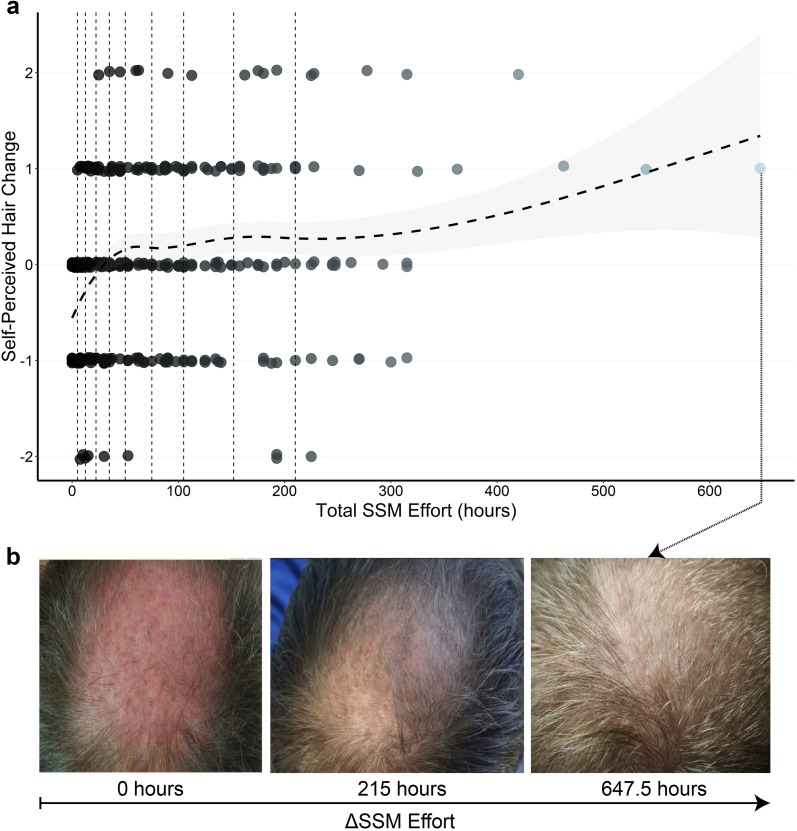
68.9% Reported Stabilisation or Regrowth — With a Clear Dose-Response Signal
A 2019 survey-based study of participants who self-administered daily scalp massage found that 68.9% reported either stabilisation of their hair loss or measurable regrowth. The study identified a clear dose-response relationship: the longer participants massaged each day, the better their outcomes. Some participants who massaged for extended daily periods — using scalp massage as their only intervention — showed near-complete recovery of the crown region. A dose-response signal of this kind is a strong indicator of genuine biological causation, not placebo effect.
The critical implication of the dose-response finding: If more daily massage time produces better results, then the primary limiting factor for most people is the effort and inconvenience of doing it by hand. A device that removes this barrier — delivering consistent, powerful stimulation automatically — is not merely a convenience; it is a clinical advantage. The question is which device does this most effectively, and whether it genuinely addresses the biological mechanisms involved.
The Two Root Causes That Scalp Massage Actually Addresses
To understand why one scalp massager dramatically outperforms another, you first need to understand the two biological processes driving androgenetic alopecia that physical scalp stimulation can interrupt.
Chronic Scalp Tension
The galea aponeurotica — a fibrous sheet of connective tissue beneath the scalp skin — can become chronically taut due to genetic predisposition, stress, and habitual muscular tension. This tautness compresses the fine blood vessels supplying hair follicles, creating localised ischaemia (reduced blood flow) that directly impairs follicle function.
The spatial distribution of this chronic tension has been mapped computationally and found to match the Hamilton-Norwood pattern of progressive hair loss with striking precision: regions of highest tension (crown, fronto-temporal zones) are exactly where hair is lost earliest and most severely. The sides and occipital region — lowest tension — retain hair lifelong even in advanced baldness.
Fibrosis & Calcification
Chronic tension doesn’t just compress blood vessels — it initiates a secondary process that compounds the damage. The resulting ischaemia and low-grade inflammation trigger the deposition of fibrous scar tissue within the scalp (fibrosis). Over time, in more progressed cases, this fibrotic tissue undergoes further mineralisation into calcified deposits.
The scalp loses its natural elasticity, becoming progressively harder and less pliable. Fibrotic and calcified tissue has even poorer blood supply than healthy tissue, creating a self-reinforcing cycle: tension causes fibrosis, fibrosis causes worse ischaemia, worse ischaemia causes more inflammation and more fibrosis. This cycle accelerates hair loss and is one reason why it becomes harder to reverse as it progresses over years.

Blood Flow, Oxygen & the DHT Amplification Loop
Tension and fibrosis converge on a single critical downstream outcome: chronically reduced scalp blood flow. The significance of this is confirmed by an unlikely source — minoxidil, the world’s most widely used hair loss drug. Research confirms that minoxidil acts primarily as a vasodilator: it widens scalp blood vessels and temporarily increases dermal blood flow. That temporary increase is why it slows hair loss. It is also direct confirmation that blood flow is the pivotal variable — and that increasing it works. The problem is that minoxidil’s effect lasts perhaps 30–60 minutes per application and does nothing to address the underlying structural cause of the deficit. Hair loss resumes immediately upon stopping because the root cause — tension and fibrosis — is completely untouched.
The consequences of reduced scalp oxygen extend beyond simple nutrient deprivation. Research by Professor Freund at the University of Arizona identified a critical biochemical consequence: in low-oxygen environments, testosterone is preferentially converted to dihydrotestosterone (DHT) rather than estradiol. Since DHT is the primary hormone implicated in follicle miniaturisation, reduced scalp oxygen does not merely starve follicles — it actively biases the local hormonal environment toward accelerated hair loss. Restoring blood flow therefore addresses both the nutrient deficit and this DHT amplification loop simultaneously. This is why improving scalp perfusion is so mechanistically powerful: it interrupts the hair loss cascade at multiple points at once.
The full cascade: Pericranial tension → compresses microvasculature → reduces blood flow → ischaemia & inflammation → fibrosis and calcification → lower oxygen tension → testosterone converts to DHT preferentially → follicle miniaturisation → progressive hair loss. Address tension and fibrosis at the source, and every downstream step in this cascade improves simultaneously.
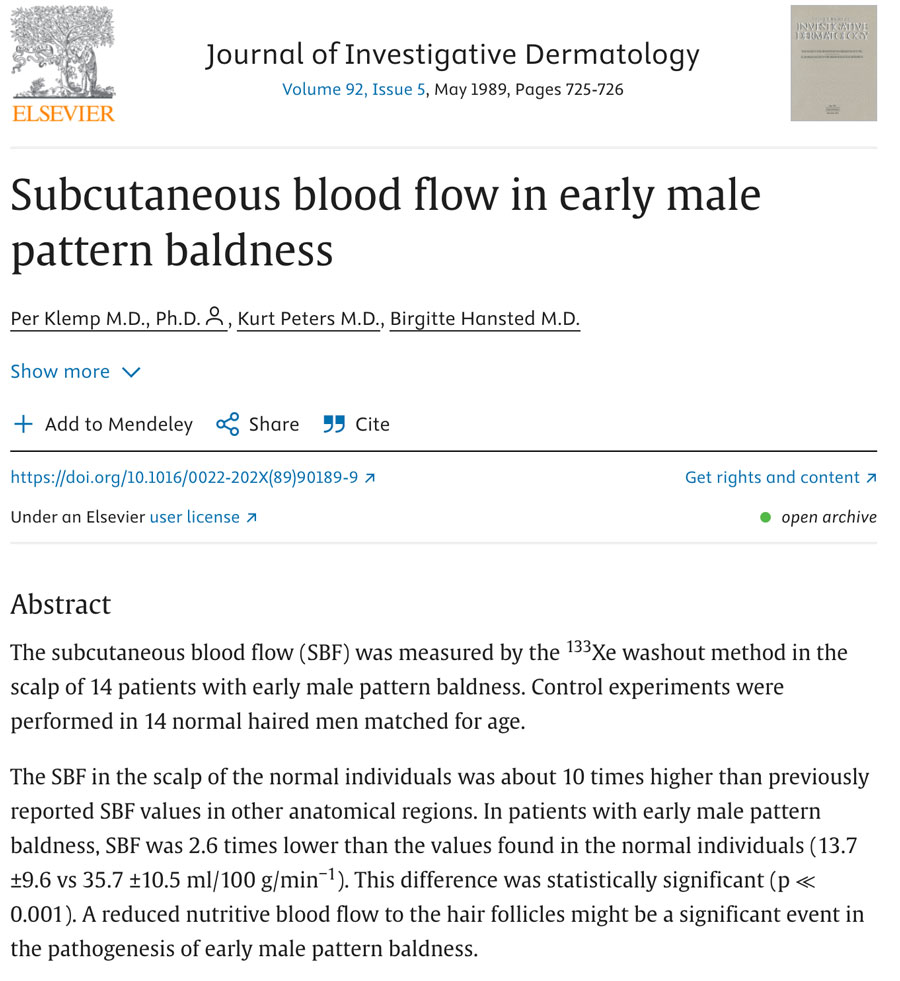
Balding Scalp Regions Have Measurably Lower Blood Perfusion
Controlled studies comparing scalp blood perfusion between men with and without hair loss consistently find a significant deficit in balding regions. This chronic ischaemia is both a cause and a consequence of hair loss — creating a self-reinforcing loop that topical vasodilators can only partially and temporarily interrupt. The structural fix requires addressing the physical cause of the vessel compression.
Relaxing Scalp Muscles Regrows Hair: The BTX Clinical Evidence
The scalp tension hypothesis moves from correlation to proven causation via a series of controlled clinical trials using botulinum toxin (BTX) injections. The logic is elegant: inject only the pericranial muscles, remove only tension, measure the result. No hormonal changes, no topicals, no lifestyle variables — just tension reduction.

Paralysing the Scalp Muscles Produced Consistent, Measurable Hair Regrowth
Researchers injected the pericranial muscles surrounding the scalp with botulinum toxin — the same substance used cosmetically to relax forehead wrinkles. By temporarily paralysing these muscles, chronic scalp tension was eliminated, microvascular compression was relieved, blood flow increased, and patients experienced measurable hair regrowth. The findings have been replicated by multiple independent research groups across different patient populations, ruling out chance or methodological artefact.
Crucially: the interventions produced zero systemic side effects, and some patients showed near-complete recovery of previously thinned areas through this single mechanism alone. This is the strongest possible evidence that scalp tension is not a secondary feature of hair loss, but a primary causal driver of it.
What the BTX trials found across cohorts:
Across Multiple Independent Teams
The hair regrowth effects of scalp muscle paralysis have been confirmed by multiple independent research groups, ruling out methodological bias or single-lab artefacts.
Systemic Side Effects
All trials reported zero systemic adverse effects. BTX injections act locally on the scalp muscles; no hormonal, cardiovascular or neurological effects were observed.
Near-Complete Recovery of Thinned Areas
A subset of patients demonstrated clinically meaningful or near-complete recovery of previously thinned crown and fronto-temporal regions through tension reduction alone.
The practical implication: BTX injections are expensive, require a clinical appointment, and must be repeated every 3–6 months as the effect fades. They are also inaccessible to most people. But the mechanism they demonstrate — that relaxing pericranial muscles restores blood flow and regrows hair — can be achieved non-invasively through consistent mechanical scalp stimulation of the right kind. The question is which device delivers this stimulation effectively enough to produce meaningful results.
Why Most Scalp Massagers Won’t Move the Needle on Hair Loss
We evaluated four categories of device against our six-point framework. Here is what we found.
Electric Prong / Octopus Massagers
These handheld devices vibrate or rotate small prong tips across the scalp surface. They are the most common “scalp massager” sold online.
- Coverage is manually controlled — inconsistent and incomplete
- Stimulates only the skin surface — no engagement of pericranial muscles
- No measured blood flow improvement in peer-reviewed literature
- No meaningful effect on fibrosis or calcification
- Requires hands to operate — poor long-term compliance
Vibrating Scalp Helmets / Caps
Full-coverage vibrating devices worn like a cap. Hands-free and convenient, but the stimulation mechanism is fundamentally limited.
- Vibration pressure is downward — adds compression rather than relieving it
- Cannot reach and stretch pericranial musculature
- No published evidence of meaningful blood perfusion improvement
- No mechanism for breaking down fibrous or calcified scalp tissue
Manual Finger Massage
The most evidence-supported of the manual approaches, with the 2019 dose-response study directly demonstrating efficacy.
- Effective in principle, but constrained by human effort and fatigue
- Coverage and pressure are inconsistent session to session
- Practically impossible to sustain 15+ minutes daily long-term
- Cannot replicate the upward lifting motion needed for full tension relief
The Growband Pro V2
The only device in our review that addresses the complete biological mechanism: tension, fibrosis, and blood flow restriction — simultaneously, automatically, every session.
- Inflatable perimeter band covers 100% of scalp in every cycle
- Upward lifting motion directly stretches pericranial muscles
- Clinically measured 87% blood perfusion increase during use
- Consistent mechanical pressure breaks down fibrotic tissue over time
- Fully hands-free — 10–15 minutes daily without any manual effort
The Growband Pro V2 by Hairguard
Manufactured by Hairguard, a UK-based hair restoration research company. The Growband Pro V2 is a patent-pending automated scalp treatment device engineered specifically to address the biological mechanisms we identified above.
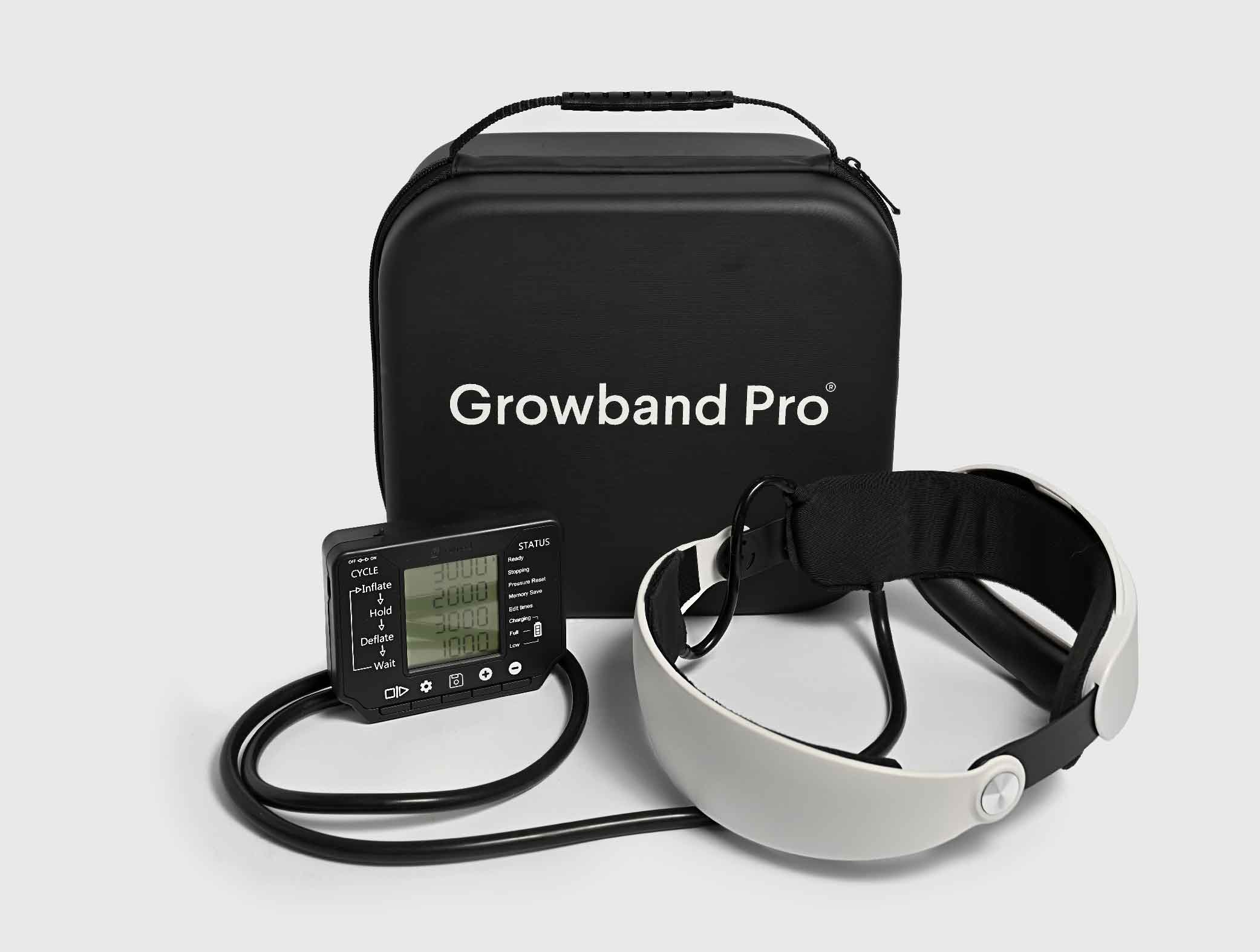
Inflatable Perimeter → Full-Scalp Lift
The Growband consists of an inflatable inner tube that encircles the forehead, sides, and back of the head, connected to the Growbox — a compact battery-operated controller that regulates programmable inflation and deflation cycles.
Each inflation pushes inward and upward from the perimeter, gripping the entire scalp margin and lifting it simultaneously. This creates a mechanical effect no other device produces: the entire crown surface is compressed, squeezed, and massaged in a single motion — while the pericranial muscles are stretched and progressively relaxed over repeated sessions.
The key difference from conventional massagers: The Growband’s upward lifting motion reduces the scalp tension that causes hair loss. Standard massagers apply downward vibration, which can actually add to surface compression rather than relieving the deeper muscular tension that matters.

Full-Scalp Mechanical Massage
Every inflation delivers a simultaneous full-scalp massage across the entire crown — covering 100% of the surface, at consistent calibrated pressure, hands-free. The coverage and consistency are practically impossible to replicate manually.

Cumulative Tension & Fibrosis Relief
The upward lifting and stretching progressively relaxes the galea aponeurotica and pericranial muscles, reducing chronic tension durably over weeks. This same consistent mechanical stimulation also breaks down fibrous and calcified tissue — restoring scalp elasticity that most people have lost over years of hair loss progression.

Pressure-Induced Vasodilation
Controlled upward pressure triggers Pressure-Induced Vasodilation (PIV) — widening of the dermal blood vessels beneath the scalp. This increases blood perfusion during each session, and cumulative sessions produce increasingly sustained improvements in baseline perfusion that persist between sessions.
Growband Pro V2 — Our Detailed Score
We scored the Growband Pro V2 against each of our six evaluation criteria on a 10-point scale, based on published evidence and device specifications.
Full Scalp Coverage
10 / 10
Pericranial Tension Relief
9.5 / 10
Blood Perfusion Impact
9.0 / 10
Fibrosis & Calcification Effect
9.0 / 10
Real-World Consistency
9.5 / 10
Clinical Evidence Base
8.5 / 10

Seeing the Mechanism in Action
This animation shows exactly what happens during an inflation cycle. As the perimeter band expands, the entire scalp margin is gripped and pulled upward simultaneously — the crown bunches, compresses inward, and is massaged from all directions at once. Every part of the top of the scalp receives the same stimulus in every cycle.
Contrast this with a handheld electric massager: you move it across one small area at a time, pressure varies with hand fatigue, coverage is inconsistent, and the direction of force is downward rather than lifting. The difference in biological effect is substantial.
- Upward lift stretches muscles — downward vibration cannot
- 100% scalp surface in every cycle — no missed areas
- Programmable cycles: same pressure, same timing, every session
- Addresses fibrosis through repeated mechanical tissue disruption
Consistent Use Is the Most Important Variable
The dose-response finding from the 2019 scalp massage study has a direct design implication: a treatment that is inconvenient to use consistently cannot produce optimal results, regardless of how effective it would be in theory.
The Growband requires 10–15 minutes daily. It is battery-operated, portable, and completely hands-free during use. Most users wear it while working at their desk, reading, or watching television — the session requires no attention once the device is on. This removes the single biggest obstacle to consistency: effort.

Your Progress Timeline
Hair growth cycles mean results develop over months, not days. Here is what consistent Growband use typically produces at each stage — based on user data and the underlying physiology of the anagen growth cycle.
Weeks 1–4
Improved scalp blood flow during sessions. Reduction in scalp tightness. Many users notice reduced daily shedding as the follicle environment begins to stabilise.
Months 2–3
Shedding stabilises for most users. Pericranial tension begins to reduce persistently between sessions. Fine regrowth hairs appear in crown and frontal zones — often noticed by others before the user.
Months 3–6
Visible density improvement across the crown. Hair shaft calibre increases as follicles re-enter full anagen production. Some users report near-complete recovery of previously thinned areas.
6+ Months
Continued improvement, even at reduced session frequency. Scalp physically softer and more pliable — indicating genuine tissue remodelling, not just surface stimulation.
Why results persist when you reduce sessions: Unlike minoxidil or finasteride, whose effects reverse immediately upon stopping, the Growband produces structural changes in scalp tissue. Reduced tension, broken-down fibrosis, and restored microvascular function are not dependent on continued device use to maintain — the tissue has genuinely changed. This is the most clinically meaningful distinction between the Growband and every pharmaceutical treatment for hair loss.
Real User Results
The following before-and-after photographs are from verified Growband users, published and assessed by Hairguard. They represent outcomes across different hair loss presentations and progression stages.
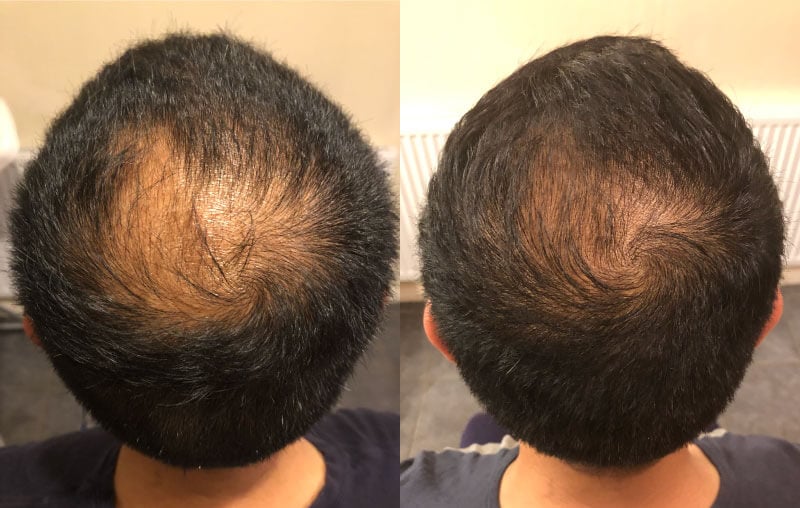
Substantial Crown Recovery
Significant improvement in coverage density across the crown and vertex after consistent daily Growband use. The regrowth pattern is consistent with follicles re-entering the anagen phase as blood flow and tissue health improved.

Hairline Advanced ~1cm Forward
Temple recession showing significant regrowth. The hairline advanced approximately 1cm forward against a fixed anatomical reference, with marked thickness improvement throughout the frontal zone. One of the more striking documented outcomes.
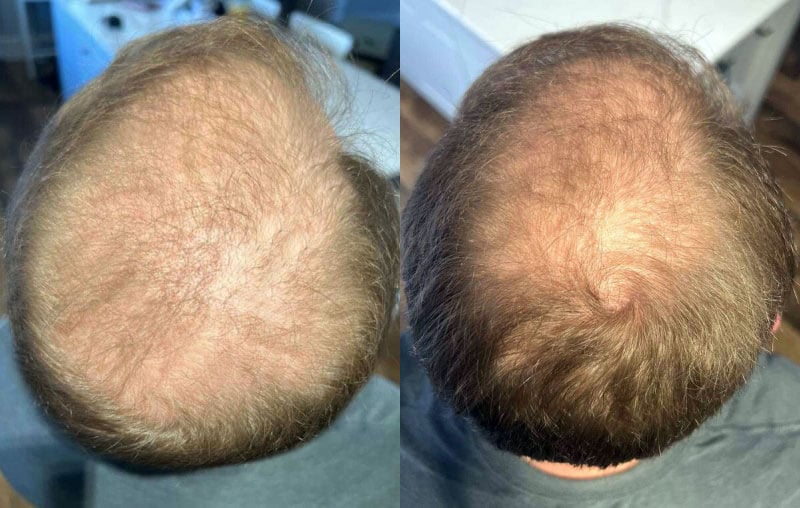
Charles — Diffuse Thinning
Improvement across the full top of the scalp. Steady crown recovery in thickness and coverage.
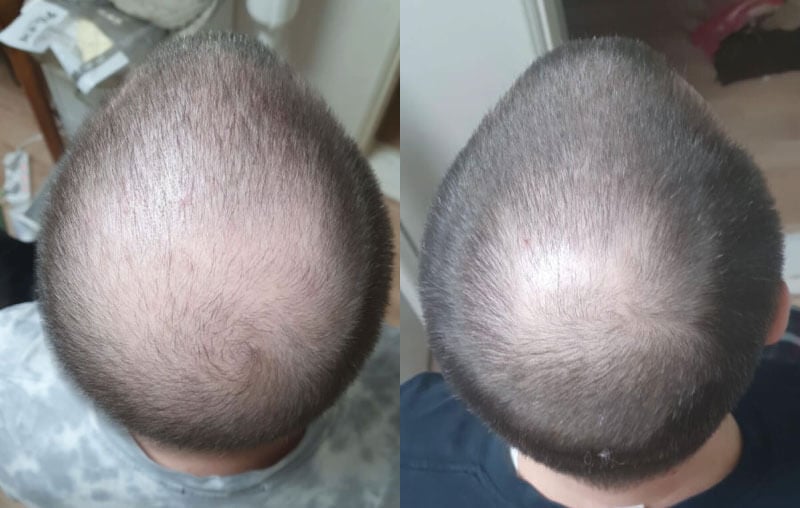
J.K. — Combined Presentation
Diffuse thinning from combined shedding disorder and MPB. Clear improvement in thickness and coverage.
The Science Behind the Growband — From the People Who Built It
Gus Slator, Product Development Head at Hairguard, joins Dr. Adam Fields DC to walk through the clinical research on scalp tension, blood flow, and what the BTX studies actually prove about the mechanism of androgenetic alopecia.
Verified Growband User Testimonials


Growband vs. Every Major Hair Loss Treatment
| Treatment | Cost Model | Addresses Root Cause | Side Effects | Effect Persists After Stopping |
|---|---|---|---|---|
| ★ Growband Pro V2 | One-off (~$397) | ✓ Tension + fibrosis | None reported | Yes — structural change |
| Minoxidil (Topical) | Recurring monthly | ✗ No | Mild (irritation, shedding) | No — reverses immediately |
| Finasteride (Oral) | Recurring monthly | Partial (hormonal only) | Significant (sexual, mood) | No — reverses on stopping |
| Hair Transplant | $10k–$20k one-off | ✗ No (moves existing hair) | Surgical risks | Yes (surgical) |
| Laser Cap (LLLT) | One-off (high cost) | ✗ No | None | Partial |
| BTX Scalp Injections | Recurring (clinical) | ✓ Tension (temporary) | None (local) | Partial — fades in months |
| Electric Scalp Massagers | One-off (low cost) | Surface only | None | Minimal |
Why We Recommend It
- Only device targeting tension and fibrosis simultaneously
- 87% blood perfusion increase — clinically measured
- Cumulative effects that build and may become self-sustaining
- Zero systemic side effects in all available data
- Hands-free design supports the consistent daily use the research demands
- One-off cost vs. indefinite pharmaceutical spend
- Synergistic with minoxidil, finasteride, and other treatments
- 30-day refund guarantee from Hairguard
What to Be Aware Of
- Upfront cost (~$397) higher than basic massagers
- Requires 10–15 minutes of daily use — consistency is essential
- Results develop over months, not weeks — patience is required
- Best evidence is for androgenetic alopecia; other hair loss types may respond differently
- Mild scalp sensitivity in the first week is common as the tissue adapts
Frequently Asked Questions
How long before I see results from the Growband?
Most users notice a reduction in scalp tightness and a decrease in daily shedding within the first 2–4 weeks. Visible regrowth typically becomes apparent between months 2 and 4, with more significant density improvements in the 4–6 month window. This timeline aligns with the biology of the hair growth cycle: once a follicle transitions from the resting phase back into active anagen growth, it takes 2–3 months for a new hair to become visible above the scalp surface. Consistency during this early period is critical — the biological changes are happening even when you cannot yet see them.
How is the Growband different from a standard electric scalp massager?
The fundamental difference is the direction and type of mechanical force applied. Standard electric massagers vibrate or rotate small points downward onto the scalp surface. The Growband inflates from the perimeter and pushes upward, lifting the entire scalp margin simultaneously. This upward lifting motion stretches the pericranial muscles — something downward vibration cannot achieve — and triggers Pressure-Induced Vasodilation. It also covers the entire scalp surface automatically in every cycle, with consistent programmable pressure, without any manual effort. These are not incremental differences; they address entirely different parts of the biological mechanism.
Can I use the Growband alongside minoxidil or finasteride?
Yes — and the combination is likely more effective than either approach alone. Minoxidil and the Growband both increase scalp blood flow, but through different mechanisms: minoxidil via chemical vasodilation (temporary), the Growband via physical tension relief and PIV (cumulative). Used together, they address the same downstream variable from two independent angles. Finasteride acts on hormonal DHT levels; the Growband addresses the mechanical cause of the local DHT amplification loop described in the Freund research. Combining them targets the hair loss cascade at multiple independent points simultaneously. Many Growband users stack it with their existing regimen for this reason.
Can women use the Growband?
Yes. The biological mechanisms of scalp tension, fibrosis, and blood flow restriction are the same in female androgenetic alopecia as in male pattern baldness — though the distribution pattern and severity often differ. Women experiencing diffuse thinning from androgenetic alopecia or stress-related shedding disorders may respond well to the Growband’s approach. The device is adjustable and designed to fit different head sizes.
If I stop using it, will the results reverse?
This is one of the most important distinctions between the Growband and pharmaceutical treatments. Minoxidil and finasteride must be used indefinitely — their effects reverse within months of stopping because the underlying cause is untouched. The Growband, by contrast, produces structural changes in scalp tissue: reduced muscular tension, broken-down fibrotic tissue, and restored microvascular architecture. These physical changes do not immediately reverse when you stop using the device. Many users report continued improvement even after reducing session frequency, and some maintain their results at a maintenance frequency of a few sessions per week. That said, some degree of ongoing use is likely beneficial for long-term maintenance, particularly for genetic susceptibility to tension that doesn’t disappear entirely.
What happens if it doesn’t work for me?
Hairguard offers a 30-day refund guarantee. If you use the device consistently for 30 days and do not see or feel any improvement, you can return it. It is worth noting that 30 days is a short window relative to the full results timeline — most meaningful outcomes emerge at 3–6 months — but you will typically feel the reduction in scalp tightness and changes in blood flow well within the first 30 days, which gives you a meaningful early signal of whether the device is working for your scalp.
Is scalp tension the only cause of hair loss?
No — and we want to be clear about this. Androgenetic alopecia is multifactorial. Genetic sensitivity to DHT at the receptor level remains a real and significant driver. The scalp tension hypothesis does not replace the hormonal theory; it adds a mechanical dimension to it. What the research shows is that tension and fibrosis are underappreciated contributors that, when addressed, produce meaningful improvement even when hormonal factors are not changed. For many people, particularly those in early-to-moderate stages of hair loss, the mechanical approach produces results comparable to or exceeding what pharmaceuticals achieve — without the side effects and without the indefinite dependence. For advanced hair loss, combining the Growband with a hormonal approach (like finasteride) is likely to produce the best outcomes.
Our Final Conclusion
The Growband Pro V2 Is Our #1 Pick — And the Science Explains Exactly Why
We started this review with a simple question: which scalp massager is actually worth buying if your goal is to address hair loss rather than just relax your scalp? After reviewing 40+ peer-reviewed studies and applying a six-point evaluation framework grounded in the biology of androgenetic alopecia, the answer is unambiguous.
The Growband Pro V2 is the only scalp massager we evaluated that addresses all three structural root causes of hair loss simultaneously — chronic pericranial tension, scalp fibrosis, and microvascular blood flow restriction — through a mechanism that is supported by multiple independent lines of clinical evidence. Standard electric massagers, vibrating caps, and even manual massage cannot achieve this: they stimulate the surface but cannot relax the deeper musculature, break down fibrous tissue, or produce the upward lifting motion that generates sustained Pressure-Induced Vasodilation.
More importantly, the Growband’s effects compound over time and may persist when use is reduced — the biological opposite of every pharmaceutical approach to hair loss. That durability is not a marketing claim; it is the expected consequence of genuine structural tissue remodelling, as opposed to chemical symptom management.
- Only scalp massager to address tension, fibrosis, and blood flow restriction simultaneously
- 87% blood perfusion increase measured clinically — not claimed from theory
- Achieves the same mechanism as expensive BTX injections at a fraction of the cost
- Results are cumulative and may persist long after reducing session frequency
- Zero systemic side effects in all available clinical and user data
- Hands-free design enables the consistent daily use that the dose-response research demands
- Synergistic with — not in competition with — existing hair loss treatments
Ready to Try the Growband Pro V2?
Manufactured exclusively by Hairguard. Stock is frequently limited due to demand — check current availability directly on the Hairguard website.
Manufactured by Hairguard · Ships worldwide · One-off purchase · 30-day refund guarantee · No subscription required